
Hampton Roads Philharmonic
14th Performing Season
Season Presenting Sponsor: Lumenis School of Dance
A Symphonic Jewelbox
A Collection of Timeless Orchestral Gems
Sunday, October 18, 2026 | 2:30 PM
The American Theatre
Hampton, Virginia
Steven Brindle, Music Director and Conductor
Dr. Mark Johnson, Guest Conductor
Christian Wennin, Assistant Conductor
Today's Program
Coriolan Overture
Ludwig van Beethoven | 9 minutes
Welcoming Remarks
Salut d'Amour
Edward Elgar | 3 minutes
Gymnopédie No. 1
Erik Satie, orchestrated by Claude Debussy | 3 minutes
Peer Gynt Suite No. 1
Edvard Grieg | 14 minutes
I. Morning Mood
II. The Death of Åse
III. Anitra's Dance
IV. In the Hall of the Mountain King
Intermission | 10 minutes
Serenade for Winds
Richard Strauss | 9 minutes
Dr. Mark Johnson, Guest Conductor
Raffle and Stage Reset | 2 minutes
Hungarian March
Hector Berlioz | 4 minutes
Blue Danube Waltz
Johann Strauss II | 4 minutes
Closing Remarks
Rhapsody in Blue
George Gershwin, arranged by Brubaker | 10 minutes
Program Notes
-
Ludwig van Beethoven's Coriolan Overture was composed in 1807 and was inspired by the tragedy Coriolan by Heinrich Joseph von Collin. Originally a Shakespearean play, the story follows a Roman general, Gaius Marcius Coriolanus, as he is forced into exile after turning against Rome. Later on, when he leads an army toward the city, his family pleads with him to stop, forcing him to contemplate gaining revenge or his love for his family.
The work opens with powerful, dramatic chords that create a sense of determination and anger. The theme that follows is assertive and full of energy, while the contrasting motif is more lyrical, suggesting a more emotional side of Coriolan. Beethoven moves between these ideas, which give off a feeling of struggle and uncertainty.
The work ends quietly, suggesting that Beethoven favored Collin's ending, where the general kills himself, rather than Shakespeare's ending, where he is murdered. Although originally written for the play, the work can also be performed independently. Beethoven uses strong, contrasting ideas to tell the story without words. The resulting work features themes of power, conflict, and loyalty.
-
Before departing for a trip with a close friend, Elgar's fiancée, Alice Roberts, handed him a short poem. This poem, called Love's Grace, quickly captivated Elgar and made him feel so special that he in turn wrote a song called Liebesgruß (Love's Greeting).
Elgar eventually sold the piece to Schott, a music publisher; however, the piece did not sell well with its original German title. The publisher eventually changed the title to Salut d'Amour, hoping that a French title would bring in sales. This change worked, but none of the money was ever seen by Elgar.
While listening to the piece, pay close attention to the sweet consistency of the melody, demonstrating how the presence of true love can be expressed through music.
-
Erik Satie composed the Gymnopédies in 1888, with No. 1 becoming the most well-known of the three. The title refers to an ancient Greek festival called the Gymnopaedia, although it does not attempt to reference ancient Greek music. Rather, the atmosphere is calm and surreal through its simple melodies and gentle rhythms.
While originally composed for solo piano, Claude Debussy orchestrated the piece for a larger ensemble. The orchestration adds warmth and color while also keeping the peacefulness of the original. The result is a soft, floating sound that allows for the melody to remain the focus.
This piece is known for its slower tempo and relaxed character. There is no true climax, but rather the music remains restrained and reflective. The combination of Satie's simplicity and Debussy's delicate orchestration creates feelings of nostalgia and stillness amid the busyness of life.
-
Edvard Grieg composed this music for Henrik Ibsen's play Peer Gynt in 1875. The play follows Peer Gynt, whose adventures take him around the world in search of excitement, success, and ultimately a sense of self. Grieg's accompanying music helps to bring the whole story to life.
Peer Gynt Suite No. 1 was arranged using four sections of the original incidental music. It opens with "Morning Mood," which creates a peaceful picture of sunrise. "The Death of Åse" follows with a slow, emotional melody. "Anitra's Dance" provides a lighter, more graceful contrast. The suite ends with "In the Hall of the Mountain King," which features a mysterious and exciting march to conclude the work.
The suite demonstrates Grieg's use of color, melody, and drastically contrasting moods to tell a story through music. Each movement creates a different atmosphere, perfectly encapsulating the listener in the world. The work remains one of Grieg's most recognizable compositions to this day and an important example of Norwegian Romantic music.
-
Richard Strauss composed his Serenade in E-flat major in 1881 when he was just 17 years old. Written for 13 wind instruments, the piece showcases Strauss's early talent and developing compositional tone. He would later become famous for his larger orchestral works, but the Serenade beautifully demonstrates his ability to create expressive music with a smaller ensemble.
This work particularly features Strauss's Romantic style through the use of rich harmonies and lyrical melodies. The music moves effortlessly between energetic sections and graceful singing passages. This allows the instruments to take turns presenting the musical themes.
This is an excellent example of Strauss's early development as a composer. While its elegance and balance point it toward the Classical tradition, the warmer harmonies and expressiveness point it toward a more dramatic style that characterizes Strauss's later compositions.
-
This lively and militaristic piece was premiered on February 15, 1846. It features music associated with Ferenc Rákóczi, a prominent national hero in Hungary.
The compositional credit for the original melodies is not agreed upon by scholars. The march was popularized through its association with Rákóczi and the armies he led. It has also been sung by Hungarian citizens since the 18th century.
The march went through many evolutions and eventually found itself in the hands of Hector Berlioz, a French Romantic-era composer. Berlioz decided the march should be featured while preparing for a performance of The Damnation of Faust, a work he called a "dramatic legend."
His arrangement of the march was enthusiastically received by Hungarian audiences and brought a distinctly Hungarian character to Berlioz's interpretation of the Faust story.
-
Johann Strauss II's Blue Danube Waltz was premiered on February 15, 1867, in Vienna, Austria. The popularity of this waltz cannot be overstated. It has been featured in multiple forms of media, and it even serves as the unofficial Austrian national anthem.
It is no wonder that this waltz gained so much traction, as it was composed by the King of Waltzes. Johann Strauss Sr. helped popularize the waltz, leaving it to his son, Johann Strauss II, to develop it further for the concert hall. Both produced waltzes at a remarkable rate.
The Blue Danube Waltz was written to cheer up Viennese citizens after the Prussians defeated Austria. When listening, imagine the sparkling waters that Strauss conveyed in music to remind Austrians of their pride in their home. Feel the lilting melody and travel to the soft grasses of a sunny bank while admiring one of Europe's great rivers.
-
George Gershwin began his music career on Tin Pan Alley as a song plugger for a publishing firm. After growing in his musicianship from constant playing for customers, Gershwin moved to Broadway. However, Rhapsody in Blue is what gave Gershwin his everlasting fame.
The piece was written for Paul Whiteman's "Experiment in Modern Music." This concert was meant to demonstrate how jazz could be further amplified through a symphonic setting. Gershwin wrote Rhapsody in Blue on his upright piano, later handing it off to be orchestrated for symphonic playing purposes.
Gershwin described the piece as a musical portrait of America's energy and diversity. One of the most notable sections of this piece is at the beginning with the glissando of the clarinet. Its sumptuous movement introduces the character of the piece and places the listener within a sound world that flows like a lazy river. This solo is now one of the most famous clarinet solos in the orchestral repertoire.
Our Season Presenting Sponsor
Lumenis School of Dance
The Hampton Roads Philharmonic gratefully recognizes Lumenis School of Dance as the Season Presenting Sponsor of our 14th performing season.

Meet the Conductors
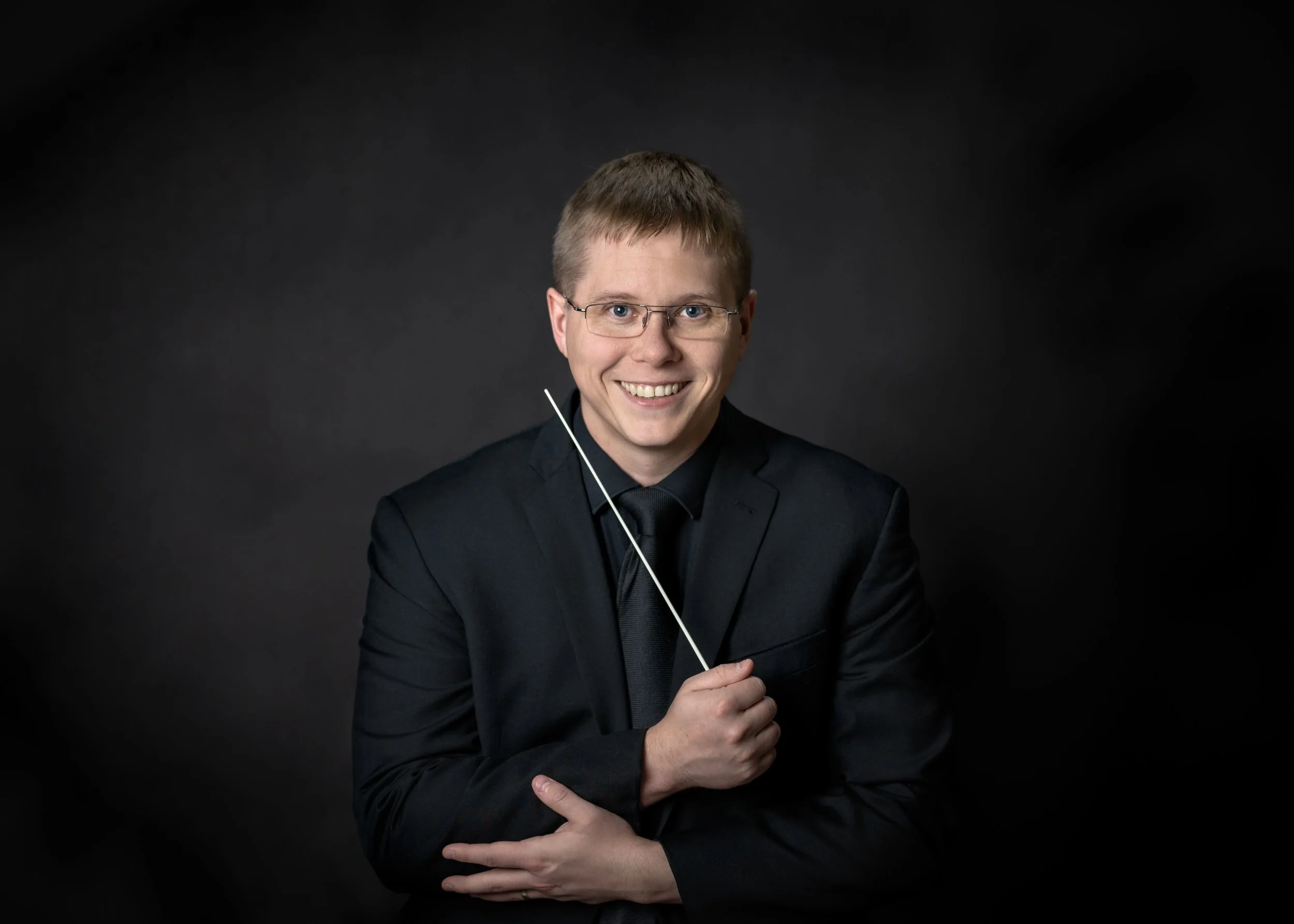
Dr. Mark Johnson
Dr. Mark P. Johnson is Director of Athletic Bands at Christopher Newport University, where he directs The Marching Captains and the Pep Band, conducts the CNU University Band, and teaches Secondary Instrumental Methods in the graduate program. Before coming to Christopher Newport, Dr. Johnson served as Director of Bands at Wilkes University, where he conducted the Wilkes University Civic Band, Jazz Ensemble, and Colonel Athletic Bands, and taught music theory and music history. Dr. Johnson taught music in grades 6 through 12 in North Carolina and South Carolina. Under his direction, the ensembles consistently earned high ratings at state and regional festivals, and his students frequently placed in regional and state honor bands.
Dr. Johnson is an active guest clinician, performer, and adjudicator throughout the United States and abroad. In January of 2025, his ensembles performed in London, England, as part of the internationally renowned London New Year's Day Parade. As an advocate for new music, Dr. Johnson has commissioned and premiered works by Katahj Copely, Michael Markowski, Ruby Fulton, Steve Danyew, Joseph Samuel, Andrew Blair, and Roger Zare. His research focuses on analyzing and promoting music written by composers from underrepresented populations. His work has been cited in two volumes of the Teaching Music through Performance in Band series and featured at the GASI conference in Seoul, South Korea, and the Society for American Music National Conference. Dr. Johnson holds a D.M.A. from The University of Southern Mississippi and an M.M. and B.M.E. from Winthrop University. His primary teachers are Dr. Catherine Rand and Dr. William F. Malambri. He lives in Newport News, VA, with his wife, Kasey, and their daughter, Layla.
Guest Conductor
Steven Brindle
Steven is a conductor, cellist, and music educator who works with students and ensembles of all ages. He earned his degree in Music Education from Christopher Newport University and has also attended conducting workshops at the College-Conservatory of Music at the University of Cincinnati and the Peabody Conservatory.
Since 2013, Steven has served as the founding Music Director of the Hampton Roads Philharmonic and, since 2016, as the conductor of the Bay Youth Concert Orchestra. He regularly appears throughout Hampton Roads as a guest conductor and adjudicator. He has served as the Music Director for Tidewater Opera Initiative, conductor for Symphonicity’s productions of The Nutcracker, and conductor for Capitol Opera Richmond.
Steven lives in Ghent, Norfolk, teaches music at Ghent Montessori School, and maintains a private lesson studio. He is a member of the National Association for Music Education, Omicron Delta Kappa, Pi Kappa Lambda, Alpha Chi, and Phi Mu Alpha Sinfonia.
Music Director and Conductor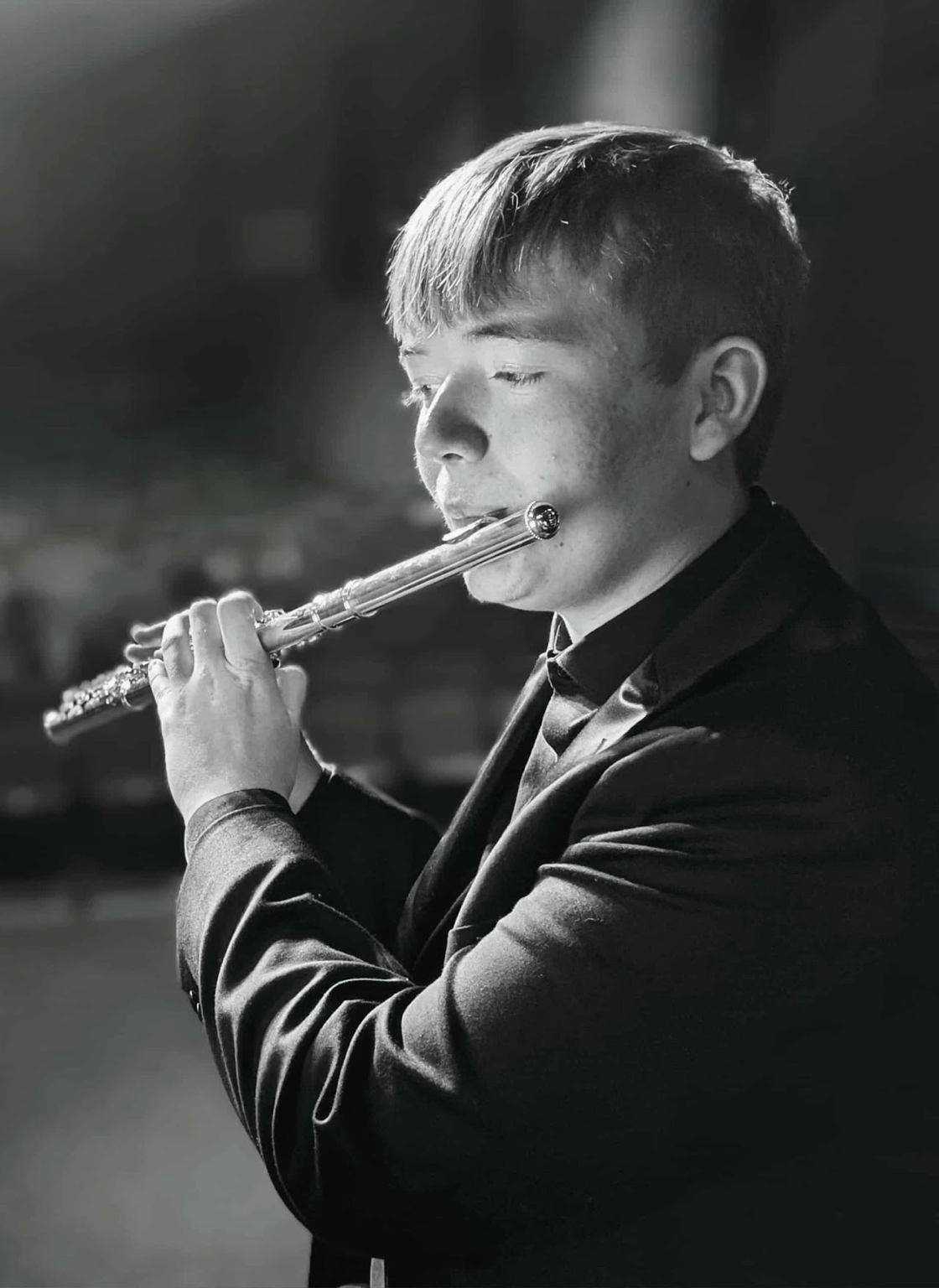
Christian Wennin
Christian is a music educator, flutist, and conductor based in Newport News, Virginia. He is currently pursuing a Bachelor of Music in Instrumental Music Education at Christopher Newport University.
In addition to his role as Assistant Conductor with the Hampton Roads Philharmonic, Christian has served as a student conductor with the CNU Wind Ensemble, Williamsburg Youth Orchestra, and Menchville High School Symphonic Band. He has studied conducting privately with Dr. Mark Reimer of Christopher Newport University and Dr. David Grandis of William & Mary.
Christian also performs with the Chesapeake Bay Wind Ensemble and serves as a substitute flutist with the Hampton Roads Philharmonic. He is a member of the National Association for Music Education, International Conductors Guild, and Society of Composers, Inc., and is a probationary member of Phi Mu Alpha Sinfonia.
Christian continues to grow as a performer, conductor, and educator, with a particular passion for creating meaningful musical experiences with others. He often shares a simple philosophy that reflects his approach to music and education: “Music isn’t a part of my life, it IS my life."
Assistant ConductorHampton Roads Philharmonic Musicians
-
Violin I
Alice Cryer
Lauren Bristow
Mary Huber
Luke Heddle
Janet Nelson
Keri HouserViolin II
Steve Wood
Jessica Baker
Kimberly Lorenz
Kendall Orndoff
Myfanwy Morgan
Margaret Mastbrook
Jack MurrayViola
Bryan Williams
Jan Ryan
Laura Gerlach
Will Hederer
Sarah QuemadaCello
Joanna Pearson
Shea Matthews
Kate Perkins
Daniel Williams
Kira Malone
Becky SmithsonBass
Kevin Garner
Marcia DePriestHarp
Melvin Lauf, Jr.
Mark Hendrickson -
Flute
Cathy Francis
Christian WenninOboe
Jenna Eppink
Adam RiceEnglish Horn
Todd Worsham
Clarinet
Gene Chieffo
Camiel SimsBass Clarinet
Jennifer Lambert
Bassoon
Mike Marshall
Chris Simmons -
Horn
Chelsey Hamm
Emily Judd
Julia Campbell
Christin LundgrenTrumpet
Christian Van Deven
Cameron Baker
Barb YaegerTrombone
Mark Hendrickson
Steven Thompson
David BasonTuba
Todd Brubaker
-
Timpani
Casey Jones
Percussion
Michelle Price
Orchestra Staff
Music Director & Conductor – Steven Brindle
Assistant Conductor – Christian Wennin
Executive Director & Orchestra Manager – Eugene Chieffo
Librarians - Christian Van Deven and Cathy Francis
Social Media Director– Emmet Aylor
Student Intern - Abby Russell
Board of Directors
Chair – Mark Hendrickson
Vice Chair - Dr. Chelsey Hamm
Secretary – Shea Matthews
Treasurer – Stephen Wood
David Bason
Keri Houser
Dr. Christoph Leemann
Shea Matthews
Lynn Sebacher
Bryan Williams
Thank You to Our Supporters
The Hampton Roads Philharmonic gratefully acknowledges the individuals, families, organizations, and community partners whose generous support helps make our performances possible.
Thank you for supporting live orchestral music in Hampton Roads.
-
Newport News Arts Commission
Virginia Commission for the Arts
Anonymous
Mr. John Dorsey
David & Shu Ling Heddle
Dr. Christoph Leemann
Michael & Valerie Marshall
George & Janet Nelson
Steve & Sharon Rossman
Lynn M. Sebacher
Molly & Forrest Ward
Stephen Wood & Eileen Chadis Wood -
Mark Hendrickson
Mr. & Mrs. Peter Morgan
Shirley Sebacher
Roberta & Jeff Tunstall -
Eugene & Michel Chieffo
Alice Cryer
William Davenport
Janna Fitzgerald
Dr. Chelsey Hamm
Christopher Matthews
Mr. & Mrs. Ray Walsh
Peggy & Chip Watson
Charlie & DJ Whittaker -
David & Shirlie Anson
Ms. Donna Berg
Patrick Beste
David Bason
Lydia Crim
Virginia Glover
Edna Griffenhagen
Florian Hauenstein
Mike Johnson
Ellen McDade
Wade Morris
Laurie McNemar
Sarah Quemada
William Schearer
Camiel Sims
James O. & Judy Torrey
Donnie & Robie Tuck
Dr. Richard Wertime -
Mr. & Mrs. Stephen Adams
Julie Bednarek
Leo Chan
Joseph Drewry
Billie Einselen
Katherine Freakley
Shahana Keisler
Lydia S. Matthews
Linda & Ronald Minetree
Joanna Pearson
Mr. & Mrs. James Savinsky
Matthew Simon
Phillip Simonetta